Digital software / Download
PSynth3
Windows x64 · VST3 · standalone
…
About PSynth3
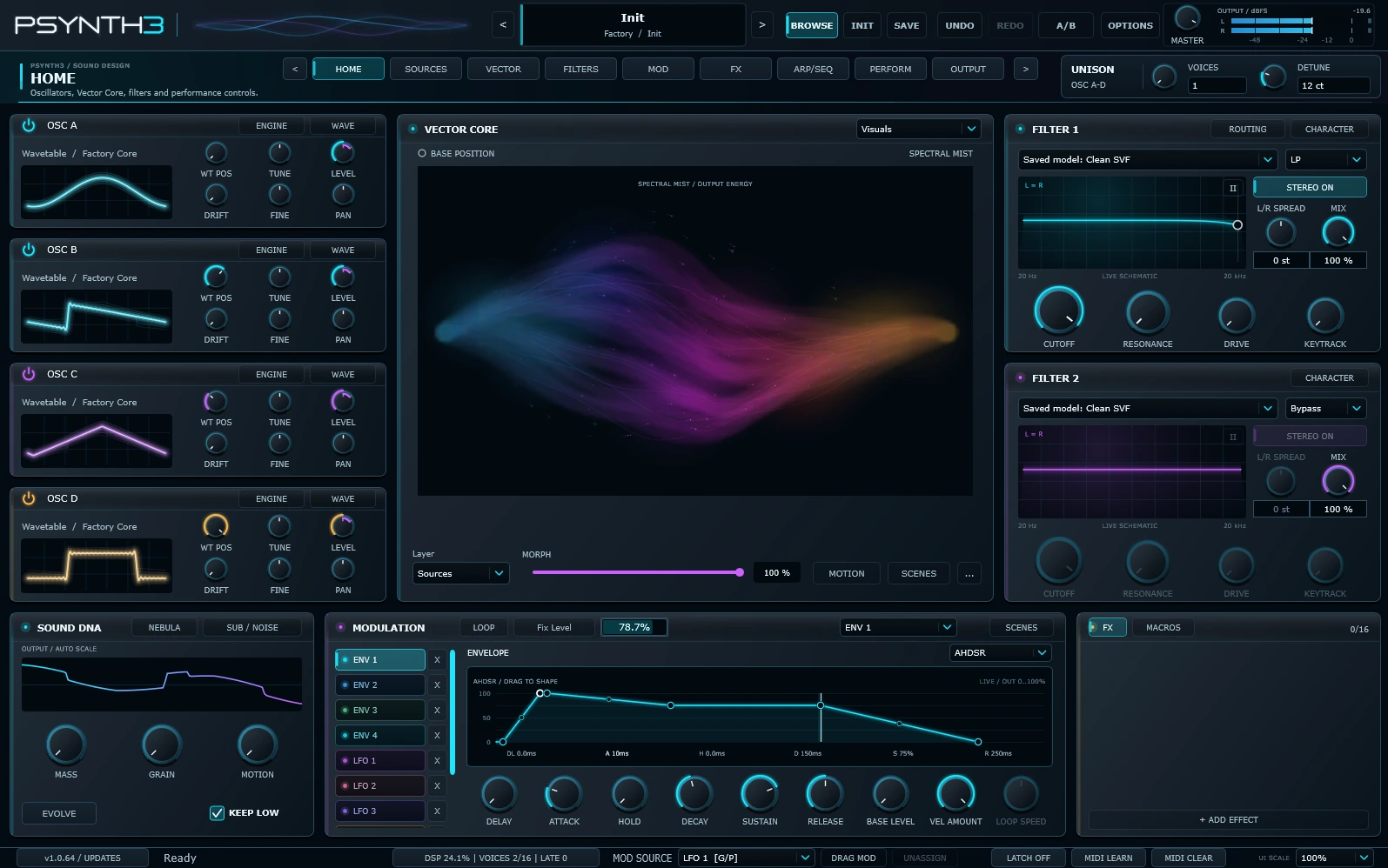
Hold a chord and move across the Vector Core pad. A bell-like FM attack gives way to a wavetable pad, the filter opens, and the reverb comes up. You decide what happens at each corner and how far the sound changes between them. Play that movement by hand, record it as an XY gesture, or loop it in time with your track.
Four oscillators, thirteen engines
Each oscillator slot can run a different engine. Use Vintage for a pulse bass with a solid sub layer, then add Ember for an attack that bites harder as you play and slides between overlapping notes. Crosswind combines oscillator sync and ring modulation. Foundry drives a three-oscillator mixer inside a single slot. Prism blends classic waveforms with wavetables, while FM Operators gives you four operators for glassy keys, bells and metallic percussion.
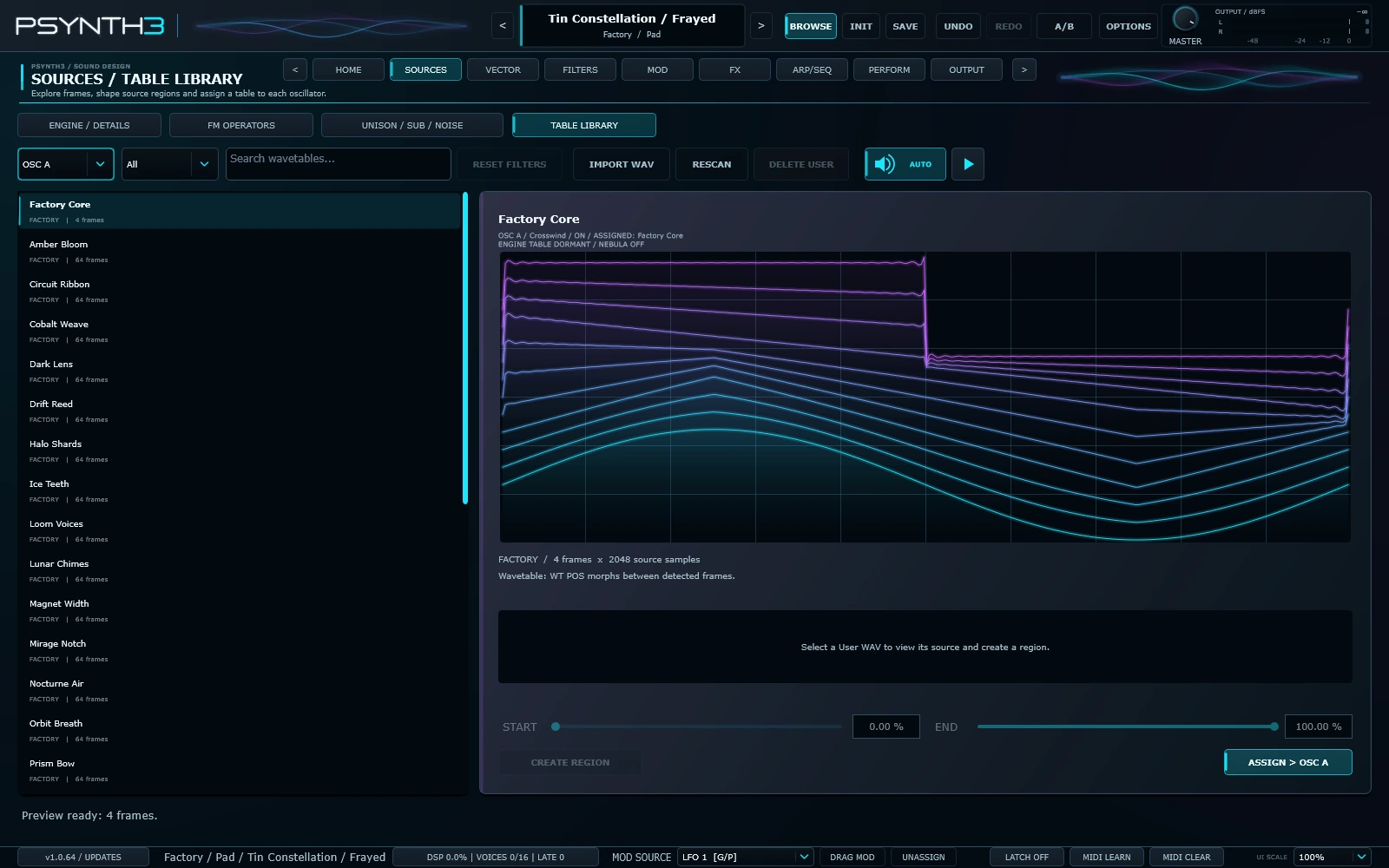
The full engine lineup includes Wavetable, Vintage, Hard Digital, Electric, FM Operators, Voltage, Poly Circuit, Reed, Ember, Crosswind, Foundry, Prism and Lumen. Import a WAV to build your own wavetable, or use Nebula Cloud to turn a steady tone into a drifting cloud of grains.
Two filters, twelve models
Try Ladder on a saw bass for a rounded sweep, tune Comb until a short pluck starts to ring, or sweep Formant between vowels. The circuit models each have their own controls. Contour responds to input level, so the cutoff can shift as you drive it. Cinder adds a sharper edge, while Compass lets you trim the low end independently of the resonant low-pass cutoff.
Choose from Clean / Multi, Ladder, OTA 12, Comb, State Variable, Formant, Voltage LP, Palisade, Contour, Cinder, Compass and Prism. Route each oscillator to either filter, both, or the direct path. Run the filters in parallel to keep two layers distinct, or in series to shape one sound in two stages.
From the first note to the finished patch
Four LFOs, four envelopes and two drawable MSEGs give you control over how a patch moves. Assign several destinations to one of the eight macros to bring in vibrato, brighten the filter and raise the delay send with a single turn. MIDI Learn brings those controls onto your hardware, and MPE lets you shape individual notes within a chord.
The arpeggiator, chord memory and 32-step sequencer let you build a part inside the patch, down to the probability and repeats of individual steps. The 16-slot effects rack can run in series, in parallel or as a send-and-return setup. Keep a pluck dry and close in the main path, then send just enough of it to a long reverb to leave space around the notes.
PSynth3 is available as a VST3 instrument and a standalone application for Windows x64. We’re continuing to develop it, with more factory sounds, new sound-design and performance features, and workflow refinements planned for future releases.